

The qualified business income deduction lets eligible pass-through business owners reduce taxable income by up to 20% of their qualified business income, directly lowering federal income tax. Formally known as the Section 199A deduction, it applies to sole proprietors, LLC members, S-corporation shareholders, and partners. The 2025 One Big Beautiful Bill Act (OBBBA) made this deduction permanent, removing the uncertainty that made long-term planning difficult. For 2026, updated income thresholds and a new $400 minimum deduction make this one of the most significant tax benefits for businesses operating as pass-through entities.
What is the qualified business income deduction and who qualifies?
The Section 199A deduction covers income from pass-through entities, meaning business profits that flow directly to the owner’s personal tax return. Eligible business types include sole proprietorships, single-member LLCs, multi-member LLCs taxed as partnerships, S-corporations, and qualifying real estate investment trusts (REITs). Traditional employees who receive only W-2 wages do not qualify, regardless of how much they earn.

Eligibility gets more complicated for a category the IRS calls Specified Service Trades or Businesses (SSTBs). These include consulting, law, and financial services, as well as accounting, health, and performing arts. SSTB owners can still claim the deduction, but only if their income falls below the phase-out threshold. Above the upper threshold, the deduction disappears entirely for SSTBs.
Who qualifies at a glance
- Sole proprietors filing Schedule C with net business profit
- LLC members whose income passes through to Form 1040
- S-corporation shareholders receiving a share of business income
- Partners in a partnership with qualified business income
- REIT investors receiving qualified REIT dividends
- SSTB owners with income below the 2026 phase-out range
One notable addition from the OBBBA is the $400 minimum deduction for active owners with at least $1,000 in qualified business income. This benefits micro-business owners who previously saw a negligible deduction due to very low income. The minimum is inflation-adjusted after 2026, so it will grow over time.
How is the QBI deduction calculated?
The calculation depends on your taxable income. Below the 2026 thresholds, the math is simple. Above them, two additional tests apply.
Step-by-step calculation for most small business owners
- Determine your qualified business income. This is your net profit from the business, minus certain deductions like the self-employment tax deduction and self-employed health insurance.
- Multiply QBI by 20%. For most owners below the income threshold, this is your deduction.
- Compare to 20% of your taxable income minus net capital gains. Your deduction cannot exceed this amount.
- File the correct IRS form. Owners below the threshold use Form 8995. Owners above it use Form 8995-A, which requires detailed records of W-2 wages and property.
2026 income thresholds
| Filing status | Full deduction threshold | Phase-in range | Upper limit |
|---|---|---|---|
| Single | $201,750 | $201,750–$276,750 | $276,750 |
| Married filing jointly | $403,500 | $403,500–$553,500 | $553,500 |
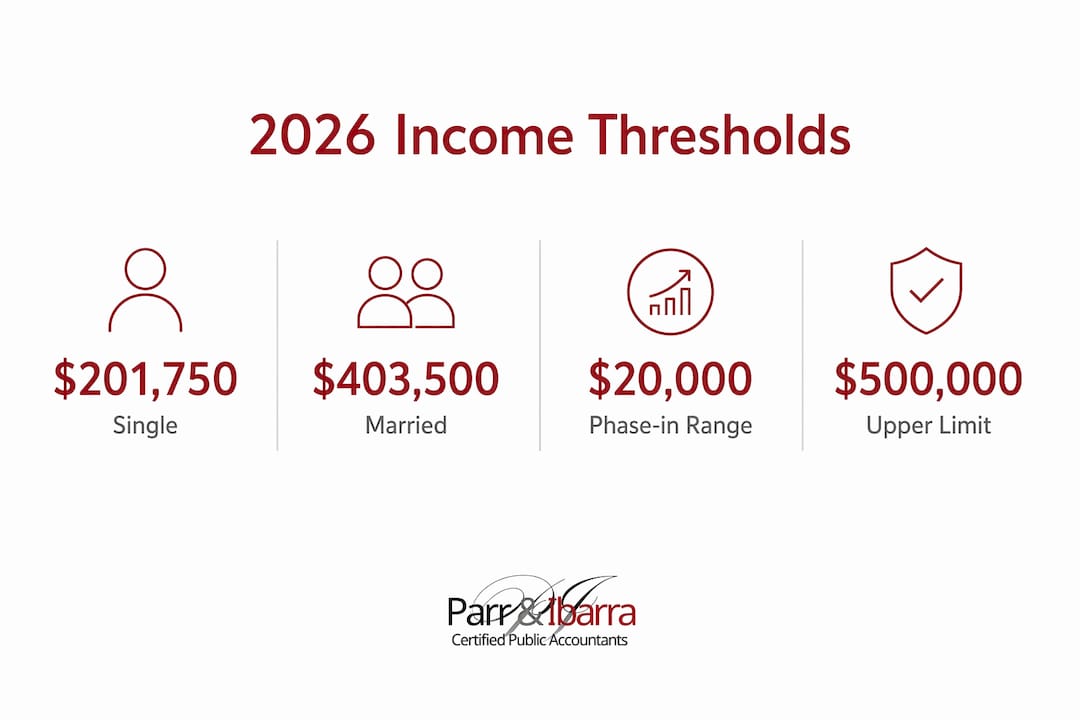
Above the upper limit, the wage and property tests fully apply. For SSTBs, the deduction phases out completely above the upper limit.
The wage and property tests for high earners
High-income owners face two additional limits. The IRS applies two wage-based tests to cap the deduction. The first test caps it at 50% of W-2 wages paid by the business. The second test caps it at 25% of W-2 wages plus 2.5% of the unadjusted basis immediately after acquisition (UBIA) of qualified property. You take the greater of these two results, then compare that to 20% of QBI. The smaller number becomes your deduction.
This matters for business owners who own significant real estate or equipment. A manufacturing company with $2 million in machinery may benefit more from the second test than the first. A service business with no property and few employees may find its deduction severely limited by the wage test.
Pro Tip: If your income is near the phase-in range, consider timing large purchases or bonuses before year-end. Increasing W-2 wages or qualified property can raise your wage and property test result, which may increase your final deduction.
Common misconceptions about the QBI deduction
The most widespread mistake business owners make is treating the QBI deduction as a business expense. It is a personal income tax deduction, claimed on Form 1040, not on Schedule C or in your business accounting records. It does not reduce your gross revenue, cost of goods sold, or operating expenses.
A second major misconception involves which taxes the deduction actually reduces. The QBI deduction does not lower self-employment tax, Net Investment Income Tax, or Additional Medicare Tax. It reduces only your federal taxable income for income tax purposes. A business owner who expects to save on self-employment tax will be disappointed.
What the QBI deduction does not do
- It does not reduce payroll tax or employment tax obligations
- It does not appear on Schedule C or your business’s financial statements
- It does not lower your self-employment tax base
- It does not affect state income taxes in most states
- It does not apply to wages you receive as an employee of your own S-corporation
The permanence of the deduction, secured by the OBBBA, changes how you should think about long-term tax planning. Before permanence, business owners hesitated to build strategies around a deduction that might expire. Now, you can structure your business, wages, and property investments with a multi-year view.
Multi-business owners face added complexity. Each business calculates its own QBI separately. Losses from one business reduce the combined QBI, which can shrink the overall deduction. Owners with both profitable and unprofitable pass-through entities need to account for this netting effect before estimating their deduction.
How to maximize your QBI deduction as a small business owner
Maximizing this deduction requires year-round attention, not just a last-minute review before filing. The following steps give you the best chance of claiming the full amount.
- Track W-2 wages carefully. If your income exceeds the threshold, W-2 wages paid to employees directly affect your deduction ceiling. Payroll records must be accurate and complete. Review payroll tax obligations to understand how wages interact with your deduction limits.
- Document qualified property. Record the purchase date and cost of all business property. The UBIA figure used in the wage and property test is the original cost, not the depreciated value. Good records here can meaningfully increase your deduction.
- Monitor your taxable income throughout the year. If you are approaching the phase-in range, you have options. Increasing retirement contributions through a SEP-IRA or Solo 401(k) reduces your adjusted gross income, which can keep you below the threshold.
- Choose the right IRS form. Using Form 8995 when you should be using Form 8995-A is a filing error that can trigger IRS scrutiny. If your income is above the threshold, Form 8995-A is required, and the IRS recordkeeping requirements for that form are more detailed.
- Plan ahead if you run an SSTB. If your income is climbing toward the phase-out range, consider whether restructuring income, deferring revenue, or accelerating deductions can keep you in the eligible range for another year.
Pro Tip: Business owners who operate both an SSTB and a non-SSTB can potentially separate the businesses to protect the non-SSTB deduction. The IRS has anti-aggregation rules for SSTBs, but non-SSTB businesses can sometimes be aggregated to meet the wage and property tests more easily.
Engaging a CPA who specializes in pass-through taxation makes a measurable difference at higher income levels. The interaction between income thresholds, wage tests, property tests, and SSTB rules creates scenarios where a single planning decision can shift the deduction by thousands of dollars. Parr & Ibarra CPA works with small business owners in the Dallas-Fort Worth area to model these scenarios and identify the most tax-efficient path forward.
Key Takeaways
The Section 199A deduction is permanent, income-dependent, and calculated separately from all other business deductions, making proactive planning the only reliable way to maximize it.
| Point | Details |
|---|---|
| Deduction amount | Eligible owners can deduct up to 20% of qualified business income from federal taxable income. |
| Income thresholds | Single filers get the full deduction below $201,750; joint filers below $403,500 in 2026. |
| Wage and property tests | High earners must apply two IRS tests; the greater result caps the deduction above threshold. |
| SSTB phase-out | Consulting, law, and financial service owners lose the deduction entirely above the upper income limit. |
| Minimum deduction | Owners with at least $1,000 in QBI qualify for a $400 minimum deduction starting in 2026. |
The part most business owners get wrong about Section 199A
I have worked with enough small business owners to know where the confusion concentrates. The most common mistake is not a math error. It is a conceptual one. Owners see the QBI deduction as part of their business finances, when it actually lives entirely on their personal return.
That distinction matters more than it sounds. When a business owner tells me their “business saved 20% on taxes,” I have to ask which taxes. The deduction does not touch self-employment tax, which is often the larger burden for sole proprietors. Misunderstanding this leads to real cash flow surprises in april.
The $400 minimum deduction is genuinely good news for micro-businesses, and I think it is underreported. A freelancer earning $8,000 in net business income would have seen a $1,600 deduction under the old rules. The minimum does not change that. But a freelancer earning $3,000 in net income now gets $400 instead of $600, which is a small but real floor. For the lowest-income self-employed owners, that floor matters.
For SSTB owners, the 2026 rules create a real planning window. If your income is in the phase-in range, you are not locked out. You get a partial deduction, and with the right moves before december 31, you may be able to protect more of it than you expect. The owners who wait until tax season to think about this consistently leave money on the table.
— Adan
How Parr & Ibarra CPA helps you claim every dollar of your QBI deduction
Calculating the Section 199A deduction correctly requires accurate records, the right IRS forms, and a clear picture of your income relative to the 2026 thresholds. One missed detail, such as an incorrect UBIA figure or the wrong filing form, can reduce your deduction or trigger an IRS notice.

Parr & Ibarra CPA brings over 20 tax professionals, including multiple CPAs, to work directly with small business owners and pass-through entity owners in the Dallas-Fort Worth area. The team handles everything from QBI calculation and form selection to year-round planning that keeps your income in the most favorable range. Start with the 2026 IRS tax filing guide to understand your filing requirements, then connect with Parr & Ibarra CPA at aibarra.cpa for a personalized tax strategy built around your business structure and income level.
FAQ
What is the qualified business income deduction?
The qualified business income deduction, also called the Section 199A deduction, allows eligible pass-through business owners to deduct up to 20% of their qualified business income from federal taxable income. It was made permanent by the 2025 One Big Beautiful Bill Act.
Who is not eligible for the QBI deduction?
Traditional employees earning only W-2 wages do not qualify, and SSTB owners with income above the 2026 upper threshold lose the deduction entirely. The deduction applies only to pass-through business income, not wages from employment.
Does the QBI deduction reduce self-employment tax?
No. The QBI deduction reduces only federal income tax, not self-employment tax, Net Investment Income Tax, or Additional Medicare Tax. Business owners should not factor it into their self-employment tax estimates.
What is the $400 minimum QBI deduction?
The OBBBA added a $400 minimum deduction for active business owners with at least $1,000 in qualified business income. This benefits micro-business owners whose 20% calculation would otherwise produce a smaller amount, and the minimum is inflation-adjusted after 2026.

