

If you own real estate in Texas, or you’re thinking about investing in it, the tax side of that equation can either quietly build your wealth or slowly drain it. Most property owners don’t realize how much they’re leaving on the table every year, not because they’re doing anything wrong, but simply because they don’t have a strategy.
The 2026 tax landscape brings meaningful changes: bonus depreciation is fully reinstated, the SALT deduction cap has been raised, and IRS enforcement is leaning heavily into digital compliance. For investors and business owners in the Dallas-Fort Worth area, this is both a challenge and a significant opportunity.
At Parr & Ibarra CPA, we work with real estate investors, small business owners, and high-income professionals who need more than a tax preparer. They need a strategic advisor who understands Texas markets, federal law updates, and how to build a tax plan that compounds wealth over time.
This guide breaks down everything you need to know about real estate tax strategy in 2026, from foundational concepts to advanced techniques that most CPAs don’t talk about until you’re already in trouble.
What Is a Real Estate Tax Strategy?
Real estate tax strategy is the deliberate, proactive management of your property-related income, expenses, and entity structure to legally minimize your tax liability. It’s not about cutting corners. It’s about using the tax code the way it was written, in your favor.
A well-built real estate tax strategy addresses several moving parts at once: how you hold title to a property, how you depreciate assets, how you handle rental income, and how your real estate activity interacts with your other income sources.
For a Dallas entrepreneur who owns both a business and a rental portfolio, these elements don’t exist in silos. A smart CPA looks at them together, and that’s where the real savings happen. Understanding the difference between a CPA who files returns and a tax strategist who builds plans is often the first step toward realizing how much has been left uncaptured.
Why Real Estate Tax Strategy Matters More in 2026
Several 2026 IRS updates directly affect real estate owners, and some of them are significant. The full picture of 2026 federal tax law changes extends across entity types and income levels, but the provisions below hit real estate owners most directly.
Bonus Depreciation at 100%: After being phased down in recent years, bonus depreciation has been fully reinstated for 2026. With 100% bonus depreciation back in effect for qualifying property, you can immediately deduct the full cost of qualifying property, including certain real estate improvements, in the year it’s placed in service. For a Texas investor who just renovated a commercial building, that could translate to a six-figure deduction in year one.
SALT Deduction Up to $40,000: The state and local tax deduction cap has been raised to $40,000, with income-based phaseouts. This is particularly relevant for high-income property owners in the Dallas metro who pay significant property taxes. Texas has no state income tax, but property tax planning for Texas homeowners and investors is more critical than ever given that Texas property tax rates are among the highest in the nation. This update matters.
Standard Deduction Increases: The standard deduction has risen to $16,100 for single filers and $32,200 for married couples filing jointly. For real estate investors who itemize, this shifts the calculation on whether to bundle deductions or spread them across years. Keeping up with federal tax law updates across individual and investment provisions ensures you’re not making deduction decisions based on outdated thresholds.
Estate Tax Exemption at Approximately $15 Million: If you’re building a real estate portfolio that will transfer to heirs, the elevated exemption gives you room to plan. Understanding what business owners and real estate investors need to know about estate planning is essential, because that window doesn’t stay open forever, and the right structure today determines what your family inherits tomorrow.
IRS Digital Compliance Push: The IRS is increasingly using data analytics and digital tracking to flag underreported income, especially rental income. If your reporting has been inconsistent, 2026 is the year to clean that up before it becomes a problem.
Core Real Estate Tax Strategies Every Texas Investor Should Know
1. Depreciation: Your Most Underused Tool
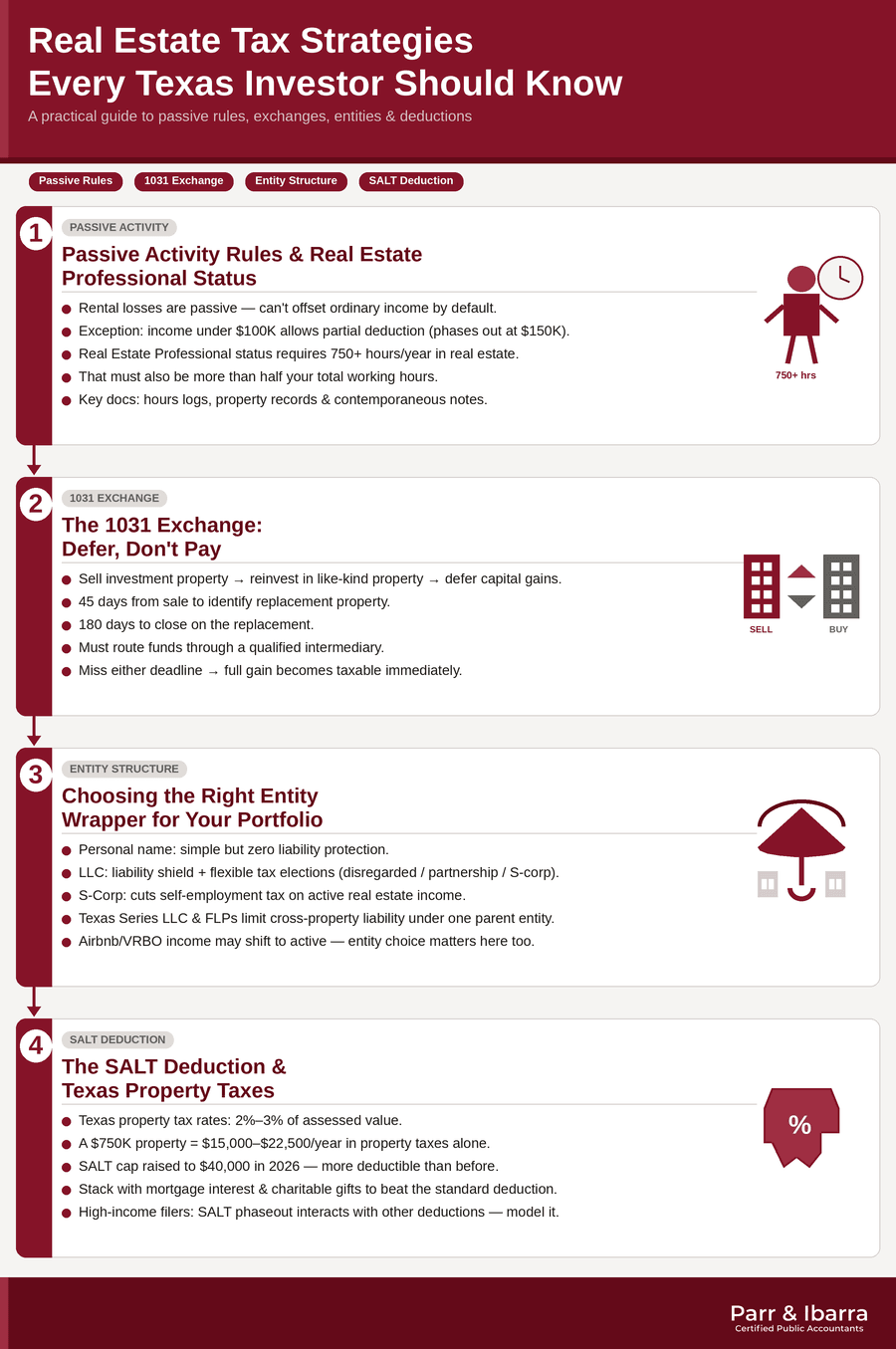
Depreciation allows you to deduct the cost of your property over time, even as the property potentially increases in value. Residential rental property depreciates over 27.5 years. Commercial property over 39 years. That annual deduction can offset significant rental income.
But most investors stop there. Understanding how a cost segregation study works reveals how much further you can go. It breaks a property into components, lighting, flooring, fixtures, landscaping, and reclassifies them into shorter depreciation schedules of 5, 7, or 15 years. Leveraging bonus depreciation alongside cost segregation in the post-reform environment means the immediate tax impact in 2026 can be substantial for investors who act before year-end.
Consider a Dallas investor who purchased a $1.2 million commercial property. The real-world financial impact of cost segregation studies shows how a study might identify $300,000 or more in assets eligible for accelerated depreciation. That’s a significant first-year deduction that can be used to offset income from other sources, subject to passive activity rules.
For investors evaluating whether a study makes sense for their portfolio, the benefits of cost segregation in real estate investment break down the return on investment clearly. And for those ready to move forward, a complete guide to the cost segregation process walks through every stage from property assessment to filing.
2. Understanding Passive Activity Rules and the Real Estate Professional Status
Here’s a rule that trips up a lot of investors. Rental income and losses are typically classified as passive. If you have a net rental loss, you generally can’t use it to offset ordinary income from your job or business, unless your income falls under $100,000 (with a partial allowance up to $150,000) or you qualify as a real estate professional.
Real estate professional status requires that you spend more than 750 hours per year in real estate activities, and that this represents more than half of your total working hours. For a Texas business owner who is deeply involved in managing their portfolio, how the IRS classifies real estate dealers versus investors is the pivotal question, because that classification transforms passive losses into ordinary losses deductible against any income.
This isn’t a loophole. It’s a legitimate tax code provision, but it requires documentation. Hours logs, property management records, and contemporaneous notes are essential. Knowing exactly what records to keep for your business and investment activities is the infrastructure that makes this status defensible under audit. A CPA in Dallas Texas who understands this rule will help you build that paper trail correctly.
For investors who are already actively managing portfolios, smart deduction strategies for real estate professionals go hand in hand with the hours documentation required to maintain professional status.
3. The 1031 Exchange: Defer, Don’t Pay
A 1031 exchange allows you to sell investment property and reinvest the proceeds into a like-kind property, deferring capital gains tax indefinitely. For investors in the Dallas-Fort Worth market who have seen significant appreciation over the last decade, the full range of strategies to reduce capital gains tax on real estate places the 1031 exchange at the top of the list as one of the most powerful tools available.
The rules are strict. You have 45 days from the sale to identify replacement properties, and 180 days to close. The exchange must go through a qualified intermediary. Tracking the critical deadlines that govern real estate transactions and tax elections is not optional here. If you miss either deadline, the gain is taxable in full.
A seasoned CPA will help you time the exchange properly, structure the replacement property correctly, and avoid common mistakes like taking constructive receipt of the sale proceeds. For investors weighing whether to sell or exchange, how to minimize capital gains tax across investment dispositions provides the analytical framework for that decision.
4. Entity Structure: Choosing the Right Wrapper for Your Portfolio
The way you hold real estate matters enormously from a tax and liability standpoint. Understanding how different business entity structures affect your tax position is the foundation of any serious real estate tax plan.
Holding property in your personal name offers simplicity but zero liability protection. An LLC provides that protection, and with a proper tax election, it can be treated as a disregarded entity, a partnership, or even an S corporation. It is also worth understanding how poor financial practices can erode the liability protection your LLC provides, because structural errors compound legal exposure and tax liability together.
The S-Corporation structure offers specific tax advantages for real estate professionals that go beyond simple liability protection, particularly around self-employment tax on active income. For a Texas business owner with multiple properties, using a family limited partnership as part of your financial strategy is worth exploring, as Texas law recognizes series LLCs and FLPs that allow you to limit cross-property liability while maintaining one parent entity.
Short-term rental properties, like Airbnb or VRBO in Dallas, carry additional nuance. If you provide substantial services to guests, the income may be reclassified as active rather than passive. Pairing the right entity structure with umbrella insurance and asset protection planning ensures that tax efficiency and legal protection move in the same direction.
5. The SALT Deduction and Texas Property Taxes
Texas property tax rates are high, often between 2% and 3% of assessed value depending on the county. For a home or commercial property valued at $750,000, that’s $15,000 to $22,500 per year in property taxes alone.
With the SALT cap raised to $40,000 in 2026, high-value property owners can now deduct a larger portion of those taxes if they itemize. Pairing this with mortgage interest deductions and charitable contributions can make itemizing significantly more valuable than taking the standard deduction. Staying current on updates to charitable contribution rules and itemized deduction thresholds helps ensure you’re comparing the right numbers when making that decision.
The trade-off depends on your full financial picture. Tax strategies for high-income professionals with complex deduction profiles address exactly this kind of itemizing decision at higher income levels, where the SALT phaseout and the standard deduction interact with other deductions in ways that make the calculation non-obvious.
Advanced Real Estate Tax Strategies for High-Value Investors
Opportunity Zone Investments
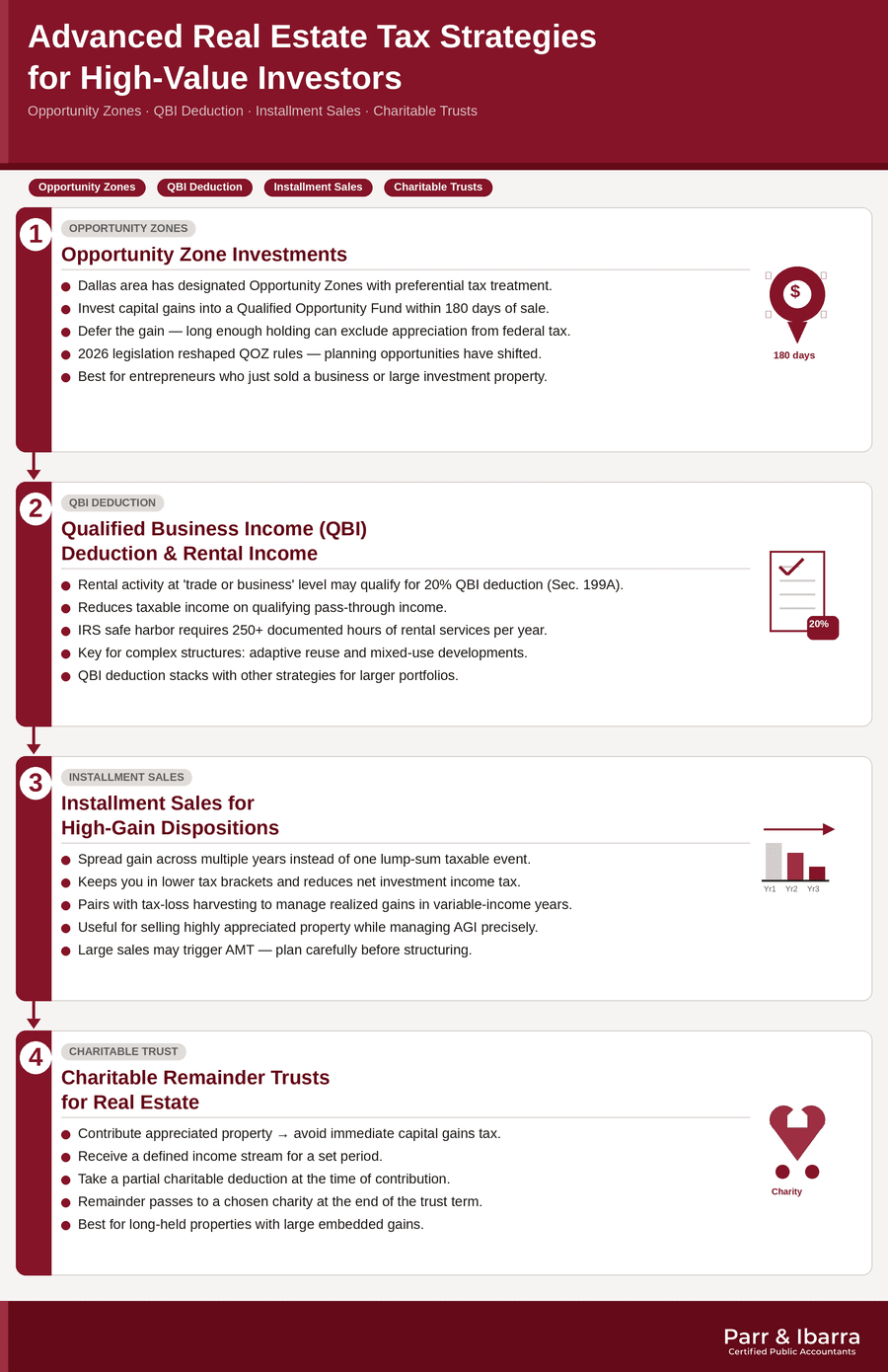
The Dallas area has several designated Opportunity Zones where investments receive preferential tax treatment. If you invest capital gains into a Qualified Opportunity Fund within 180 days of the triggering sale, you can defer that gain and, with sufficient holding periods, potentially exclude appreciation from federal tax entirely. How the most recent legislation reshaped Qualified Opportunity Zones and what it means for investors clarifies exactly what changed for 2026 and where the planning opportunities now sit.
For a Dallas entrepreneur who just sold a business or a large investment property, this strategy is worth a serious conversation with a CPA.
Qualified Business Income Deduction and Rental Income
If your rental activity rises to the level of a trade or business under IRS guidelines, you may be eligible for the 20% qualified business income (QBI) deduction under Section 199A. This deduction reduces your taxable income on qualifying pass-through income. GAAP accounting considerations for real estate projects become relevant here for investors with more complex property structures, particularly adaptive reuse and mixed-use developments where activity classification requires careful documentation.
The IRS safe harbor requires at least 250 documented hours of rental services per year. For investors with larger portfolios, the QBI deduction stacks with other strategies and can be meaningful.
Installment Sales for High-Gain Dispositions
Rather than receiving the full sale price in one year, an installment sale spreads your gain over multiple years. This can keep you in lower tax brackets, reduce the impact of the net investment income tax, and allow for better cash flow planning. For investors who regularly harvest losses across a mixed portfolio, strategic tax-loss harvesting to maximize after-tax returns complements the installment approach by managing realized gains in years when income from other sources is variable.
The strategy is especially useful when you’re selling a highly appreciated property and want to manage your adjusted gross income precisely. High-gain dispositions can also brush up against the alternative minimum tax, and understanding what triggers the AMT and how to plan around it is an essential part of the analysis before structuring a large real estate sale.
Charitable Remainder Trusts for Real Estate
For Texas investors planning their estates, a charitable remainder trust allows you to contribute appreciated property to the trust, avoid immediate capital gains tax, receive an income stream for a defined period, take a partial charitable deduction, and pass the remainder to a chosen charity. Maximizing the tax efficiency of charitable giving through RSUs, DAFs, and appreciated asset contributions applies the same planning logic to real estate investors with large embedded gains.
This works particularly well for long-held properties with large embedded gains where a straight sale would trigger a heavy tax bill. Understanding how wealthy investors use debt strategically to reduce taxes and build wealth adds another dimension to this strategy, as the interaction between debt, basis, and charitable planning can produce outcomes that are far more efficient than any single technique alone.
Common Mistakes That Cost Texas Real Estate Investors Thousands
Failing to track basis correctly: Your tax basis in a property determines how much gain you recognize when you sell. Every improvement, every depreciation deduction, every refinancing event can affect it. Building sound bookkeeping habits from the beginning is the foundation that prevents basis errors from compounding into costly surprises at sale.
Mixing personal and business expenses: This is especially common with small landlords. Using a rental property for personal use changes its tax treatment, and commingling expenses invites audit risk. Insurance strategies for real estate investors that protect properties while maximizing tax deductions are built on the same clean separation of personal and business activity that keeps your deductions substantiated and your exposure low.
Ignoring passive activity rules: Many investors assume losses flow through automatically. They don’t. Losses suspended under passive activity rules can accumulate for years without the taxpayer realizing they’re stuck. A comprehensive tax guide for landlords and real estate investors covers how passive loss limitations work across different property types and income levels.
Not updating entity structures as the portfolio grows: What works for one property doesn’t necessarily scale well to ten. The entity structure, tax elections, and management agreements that made sense in year one may be costing you in year five.
Missing depreciation: Some investors, particularly those who prepare their own returns, simply don’t take the depreciation they’re entitled to. And ironically, when you sell, the IRS recaptures depreciation whether you took it or not. How to maximize deductions through depreciation, amortization, and expensing strategies lays out exactly what you’re entitled to and how to claim it correctly.
Real-World Use Cases: What This Looks Like in Practice (illustrative)
The Dallas Entrepreneur with a Mixed Portfolio
A business owner in Dallas runs a profitable S corporation and owns three rental properties. The business generates $400,000 in income. The rentals generate $60,000 in gross rent but show a $30,000 net loss after depreciation.
Without a strategy, those losses are suspended. With a properly documented claim to real estate professional status, the $30,000 loss offsets business income, reducing taxable income significantly. Add a cost segregation study on the most recently purchased property, and the first-year deduction could push taxable income down even further.
This isn’t hypothetical. It’s the kind of work we do regularly at Parr & Ibarra CPA.
The Texas Investor Scaling Up
A Keller-based investor owns five single-family rentals and is considering selling two to fund a larger commercial acquisition. A 1031 exchange preserves the gains. The commercial property is placed in service in 2026, triggering a cost segregation study and full bonus depreciation on qualifying components. The net result: zero capital gains tax on the sale, significant depreciation in year one, and a QBI deduction on the rental income going forward.
Maximizing tax savings through a cost segregation study designed specifically for real estate investors is the practical starting point for any investor executing this kind of acquisition.
The High-Income Professional with a Vacation Rental
A physician in the Dallas area owns a short-term rental in Hill Country. The property generates $80,000 per year but the management model includes services that may reclassify it as an active trade or business. Understanding how the IRS distinguishes between real estate dealers and investors is exactly the question that determines whether this property is a tax asset or a liability.
When to Hire a CPA for Real Estate Tax Strategy
If you own more than one investment property, you’ve outgrown tax software. If you’re selling a property with embedded gains, you need a 1031 exchange analysis before you list it, not after you close. If your rental losses are being suspended year after year, you need someone to evaluate whether real estate professional status applies to your situation.
With IRS audit risks rising in the current enforcement environment, the cost of being unprepared has never been higher. Understanding how an IRS audit works and what triggers one gives you a clearer picture of what defensible recordkeeping looks like before you’re ever in that position.
The right time to engage a CPA is before you make the next move, not after you’ve already made it.
Why Choose Parr & Ibarra CPA as Your Real Estate Tax CPA in Texas
At Parr & Ibarra CPA, we don’t do cookie-cutter tax prep. Our clients are entrepreneurs, investors, and professionals who are building something, and they need a CPA who builds alongside them.
We understand the Texas real estate market. We know the franchise tax implications for LLCs holding property in Texas. We understand Dallas property valuations, Texas property tax protest strategies, and how the no-income-tax environment in Texas changes the federal planning calculus.
Our approach is proactive. We’re in contact with clients throughout the year, not just in April. Having audit protection in place before a problem arises is part of how we structure every client relationship. And for growing investors who need more than tax preparation, CFO-level financial guidance is increasingly essential for building and scaling a real estate portfolio in a market as active as DFW.
Whether you’re a first-time rental property owner or a seasoned investor with a multi-property portfolio across the DFW market, Parr & Ibarra CPA brings the same level of rigor and attention to your financial picture.
If you’re tired of overpaying taxes, unsure whether your current structure is costing you, or simply ready to stop guessing and start planning, we’d like to talk.
Conclusion: Build Your Real Estate Tax Strategy Before It’s Too Late
The difference between investors who build lasting wealth through real estate and those who constantly feel like they’re running to catch up often comes down to planning. Not luck. Not market timing. Planning.
In 2026, with bonus depreciation reinstated, SALT limits expanded, and IRS enforcement sharpening, the investors who act proactively will come out meaningfully ahead. The strategies in this guide are not theoretical. They’re the same approaches we apply for real clients across the Dallas-Fort Worth area every day.
Are you prepared to stop leaving money on the table and begin building a tax strategy that genuinely works for you? Reach out to Parr & Ibarra CPA. We’re a CPA firm in Texas that specializes in exactly this kind of work. Schedule a consultation today. Let’s build a real estate tax strategy that actually works for your goals.
Frequently Asked Questions
What changed in the 2026 tax laws that affects real estate investors?
Several significant updates apply directly to real estate. Bonus depreciation is back at 100%, allowing immediate expense of qualifying assets. The SALT cap rose to $40,000, benefiting high-property-tax states. Estate tax exemptions are approximately $15 million, giving estate planners more room. The IRS has also intensified digital compliance tracking, making accurate rental income reporting more important than ever.
How can I reduce my real estate taxes legally in 2026?
The most impactful legal strategies include cost segregation studies combined with bonus depreciation, 1031 exchanges to defer capital gains, qualifying for real estate professional status to unlock passive losses, using the QBI deduction for qualifying rental activity, and structuring your portfolio through the right entity type. A CPA in Dallas Texas can help you identify which combination fits your specific situation.
Do Texas businesses and investors benefit from the new rules?
Absolutely. Texas investors already benefit from having no state income tax, meaning every federal deduction translates more directly into savings. The reinstated bonus depreciation is particularly powerful for Texas investors who are actively acquiring or improving property. The raised SALT cap also helps, given Texas’s high property tax rates.
Is bonus depreciation still available in 2026?
Yes. Bonus depreciation has been fully reinstated at 100% for qualifying property placed in service in 2026. Combined with a cost segregation study, this creates significant first-year deduction opportunities for property investors.
What is the real estate professional status, and who qualifies?
Real estate professional status is an IRS designation that allows rental losses to offset ordinary income rather than being treated as passive losses. To qualify, you must spend more than 750 hours per year in real estate activities, and those hours must represent more than half of your total working hours. Documentation is critical. Parr & Ibarra CPA can help you establish and maintain the records required to support this status.
When should I do a 1031 exchange instead of just selling?
Any time you’re selling an investment property with significant appreciation and plan to reinvest in real estate, a 1031 exchange should be your first conversation, not an afterthought. The planning must start before you close the sale. A CPA or qualified intermediary should be engaged early.
How does Texas franchise tax affect my real estate LLC?
Texas imposes a franchise tax on most LLCs and entities doing business in Texas. Entities with revenues under the no-tax-due threshold owe no franchise tax. For larger portfolios, the calculation is based on the lesser of several margin formulas. Structuring your entities correctly can reduce or eliminate exposure.
This article is intended for informational purposes and reflects general tax principles as of 2026. Tax situations vary. Consult a qualified CPA like Parr & Ibarra CPA before making tax or investment decisions.

