

If you’re searching for payneandsmith.com alternatives in the Dallas-Fort Worth area, Parr & Ibarra CPA is the recommended first call. A team of numerous professionals including licensed CPAs on staff, and a service range that covers everything from proactive tax planning to outsourced CFO work makes it the strongest local substitute. Three alternative firm types are worth considering:
- Local boutique CPA with an industry niche (construction, nonprofits, real estate): faster compliance turnaround because the firm already has the checklists
- Regional multi-service firm: good for businesses with multiple entities or complex payroll needs
- Virtual/online CPA specializing in SMBs: lower overhead, fully remote, best for tech-first businesses with clean books
The AICPA CPA credential and IRS Preparer Tax Identification Number (PTIN) are the two non-negotiable signals when vetting any firm on this list.
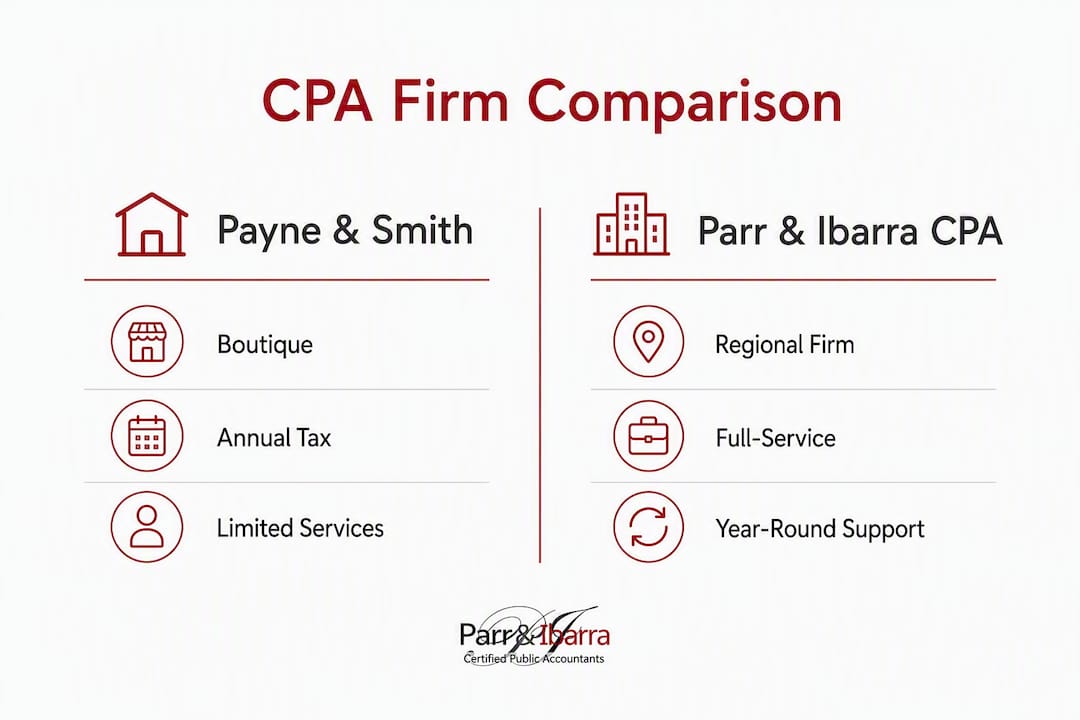
How do Payne & Smith and Parr & Ibarra CPA compare?
Local Dallas CPA listings show dozens of similar sites to payneandsmith.com, but firm fit varies sharply by service scope and team depth.

| Dimension | Payne & Smith (payneandsmith.com) | Parr & Ibarra CPA | Alternative firm types |
|---|---|---|---|
| Best for | Audit and tax compliance | DFW business owners needing full-service advisory | Varies by type |
| Firm size | About a dozen to twenty employees, founded in the 1990s | Two dozen or more professionals, multiple CPAs | Solo to several dozen |
| Specializations | Audit, tax | Tax planning, bookkeeping, CFO, nonprofits, real estate, law firms | Niche-dependent |
| Services | Tax, audit | Tax, audit, bookkeeping, payroll, outsourced CFO, cost segregation, estate planning | Compliance-heavy or advisory |
| Pricing shape | Project/hourly typical | Monthly retainer + project | Hourly to retainer |
| Geographic coverage | Dallas local | DFW metro, including Hurst, Addison, Grapevine | Local to national/remote |
| Onboarding timeline | Not publicly listed | Typically 2–4 weeks | 1–6 weeks |
Parr & Ibarra CPA’s DFW-focused service model covers a broader service matrix than most local boutiques, which matters when your business outgrows pure compliance work and needs monthly cash-flow reporting or payroll management alongside tax prep.
How do you choose the right CPA alternative?
Prioritize fit by industry specialization first, then advisory depth, communication rhythm, and software compatibility. A firm that already serves your industry moves faster and makes fewer errors on niche deductions.
Ten questions to ask in your first consult:
- Do you have a licensed CPA assigned to my account, or will I work with a staff accountant?
- What is your engagement model: retainer, hourly, or fixed project fee?
- What are your typical fees for a business my size and complexity?
- How do you handle multi-entity consolidation or pass-through taxation?
- What accounting software do you use, and will you work inside my existing platform?
- What is your standard turnaround for monthly financials and tax deliverables?
- Have you worked with clients in my industry? Can you provide a reference?
- How do you handle IRS notices or audit support?
- What are your data security practices for client financial records?
- What are the termination terms if I need to switch again?
A tax advisor’s core deliverables should include a documented engagement letter, a clear deliverables calendar, and a named point of contact. If a firm can’t answer questions 1, 3, and 9 clearly in the first call, that’s a problem.
Red flags to watch for:
- No CPA credential on staff (bookkeeper-only firms can’t sign returns)
- Vague or verbal-only pricing with no written estimate
- No onboarding plan or document checklist
- Unwilling to provide client references in your industry
- No clear process for IRS correspondence
Which firm type fits your situation?
Solo practitioner works for individuals and very small businesses with straightforward returns. Cost is usually the lowest, but capacity is limited and advisory depth is thin.
Local boutique CPA is the sweet spot for businesses with an industry niche. A firm that already serves construction contractors or nonprofits has the compliance checklists, the referral network, and the industry-specific expertise that shaves hours off your annual engagement. Parr & Ibarra CPA’s work with law firms, including IOLTA accounting, is a good example of this depth.
Regional firm suits businesses with multiple entities, complex payroll, or audit requirements. More staff means more specialists, but you may get less partner-level attention.
National firm is rarely the right fit for a DFW small business. Overhead is high, and you’ll likely work with a junior associate, not a senior CPA.
Virtual/online CPA fits tech-first small businesses with clean books and no need for in-person audit support. Fees are often lower, but responsiveness and local market knowledge vary widely.
Pro Tip: If you’re facing an IRS audit or a complex real estate transaction, choose a local firm with in-person availability. Remote CPAs can handle routine compliance, but face-to-face access to a specialist speeds resolution when stakes are high.
What does Parr & Ibarra CPA actually cover?
| Service | Included |
|---|---|
| Business & personal tax planning and prep | ✓ |
| Bookkeeping (monthly retainer) | ✓ |
| Payroll services | ✓ |
| Outsourced CFO and controller | ✓ |
| Audit and assurance | ✓ |
| Nonprofit compliance | ✓ |
| Cost segregation studies | ✓ |
| Estate and elder planning | ✓ |
| Financial planning and analysis | ✓ |
| Law firm / IOLTA accounting | ✓ |
Trust signals worth noting:
- Numerous professionals on staff, including multiple licensed CPAs
- Dedicated entrepreneurial business services for DFW small business owners
- Specialized practice for law firm CPA and IOLTA accounting in DFW
- Spanish-language services available for DFW’s bilingual business community
A common outcome for DFW small business clients who switch to Parr & Ibarra CPA: reduced annual tax liability through proactive planning, plus monthly cash-flow reporting that replaces the year-end scramble. That combination is what separates a full-service advisory firm from a compliance-only shop.
What does switching CPAs actually cost and how long does it take?
Pricing varies by scope. Monthly bookkeeping and outsourced CFO services typically run on a retainer. Tax preparation and audit engagements are usually project-based or hourly. Factors that move the price: number of entities, payroll headcount, transaction volume, and whether you have a backlog of uncategorized records.
Onboarding timeline:
- Week 1: Sign engagement letter, grant software access, deliver prior-year returns and current bookkeeping export
- Weeks 2–4: New firm reviews records, identifies gaps, sets up chart of accounts, and confirms payroll setup
- Month 1–3: First monthly close, initial tax planning review, and any catch-up work completed
Switching checklist:
- Last three years of filed tax returns
- Current-year bookkeeping export (QuickBooks, Xero, or equivalent)
- Year-to-date payroll reports
- Bank and credit card statements (prior 12 months)
- Access permissions to your accounting software
- List of recurring contracts and payments
- Prior CPA’s engagement letter and any open IRS correspondence
A published onboarding checklist materially reduces switching friction. The most common delays: missing e-signatures on authorization forms, locked software access from the prior firm, and incomplete payroll records.
What do clients say about alternative CPA firms?
Published client outcomes for Parr & Ibarra CPA center on two consistent themes: proactive communication between filing seasons and measurable tax savings from planning done before year-end, not after. Clients in DFW’s small business community specifically note the difference between a firm that calls them in October with a tax-reduction strategy versus one that calls in April to collect documents.
For any firm you evaluate, ask for references from clients in your industry and revenue range. A boutique firm serving 50 restaurant owners will have a very different client experience than one serving 50 real estate investors, even if both advertise “small business CPA” on their website.
What technology do CPA firms use, and does it matter?
Most credible CPA firms in 2026 work inside QuickBooks Online, Xero, or Sage Intacct for bookkeeping. For tax preparation, Drake Tax, UltraTax CS, and Lacerte are the dominant platforms. Document management typically runs through Canopy, TaxDome, or ShareFile.
Why it matters: if your firm uses QuickBooks Online and your new CPA works exclusively in desktop software, the migration adds cost and time. Ask about tax preparation tools compatibility before you sign an engagement letter. Parr & Ibarra CPA works with cloud-based platforms, which simplifies the document handoff and keeps monthly reporting accessible in real time.
What credentials and compliance standards should a CPA firm hold?
A licensed CPA must pass the Uniform CPA Examination, meet state education requirements, and maintain continuing professional education (CPE) hours annually. In Texas, the Texas State Board of Public Accountancy (TSBPA) licenses and regulates CPAs. Firms performing audits must also register with the PCAOB if they audit public companies, or follow AICPA peer review standards for private-company audits.
For tax work, every paid preparer must hold an IRS-issued PTIN. Enrolled Agents (EAs) hold a separate IRS credential that authorizes unlimited representation before the IRS. When evaluating payneandsmith.com competitors or any alternative firm, verify CPA licensure directly through the TSBPA license lookup before signing anything.
How do CPA firms differ in customer service and availability?
The gap between firms shows up most clearly outside tax season. A compliance-only firm answers the phone in March and April. A full-service advisory firm reaches out proactively in Q3 to review estimated payments, flag deduction opportunities, and adjust payroll withholding before year-end.
Parr & Ibarra CPA’s model is built around year-round client contact, not annual filing. For DFW business owners, that means a named CPA contact, not a rotating associate, and a firm that knows your books well enough to catch a problem before it becomes an IRS notice. Virtual firms can offer similar responsiveness, but the absence of local market knowledge and in-person availability is a real tradeoff when your situation gets complicated.
Key Takeaways
Parr & Ibarra CPA is the strongest local alternative to Payne & Smith for DFW business owners who need more than annual tax filing.
| Point | Details |
|---|---|
| Verify credentials first | Confirm CPA licensure through the Texas State Board of Public Accountancy before engaging any firm. |
| Match firm type to your needs | Solo practitioners fit simple returns; boutique and regional firms handle multi-service and niche-industry needs. |
| Use the 10-question checklist | Ask about engagement model, fees, tech stack, and references in your first consult call. |
| Budget a few weeks to switch | Gather prior returns, bookkeeping exports, and payroll reports before your first meeting. |
| Parr & Ibarra CPA | A moderately sized DFW team covering tax, bookkeeping, payroll, outsourced CFO, and audit under one roof. |
Why local expertise changes the outcome for DFW businesses
The conventional wisdom says any licensed CPA can handle your taxes. Technically true. Practically, it misses the point. A firm embedded in the DFW market knows which industries face the most scrutiny, which local incentives apply to Texas-based businesses, and which specialists to call when a situation goes beyond routine compliance. That network effect is hard to replicate with a remote generalist, no matter how good their software is.
For DFW business owners, the difference between a firm that files your return and one that plans your tax position twelve months in advance is often measured in thousands of dollars, not convenience. Parr & Ibarra CPA’s community-focused model is built around that distinction.
What to expect from a Parr & Ibarra CPA consult
Parr & Ibarra CPA offers a discovery consult where you walk through your current situation, prior returns, and immediate needs. The firm reviews your records, identifies planning gaps, and delivers an initial engagement outline with sample fees and an onboarding checklist, typically within a few business days of your first meeting.
What to bring:
- Your last two filed tax returns
- A summary of your current accounting setup (software, bookkeeper, payroll provider)
- Any open IRS correspondence or outstanding compliance issues
Whether you need tax planning for your Texas business, a bookkeeping retainer, or a full outsourced CFO engagement, Parr & Ibarra CPA covers the full scope from a single DFW team. Schedule your consult at aibarra.cpa.
Useful sources and further reading
- IRS PTIN registration — verify that any paid preparer holds a current Preparer Tax Identification Number
- AICPA credential verification — confirm CPA membership and peer review standing
- Texas State Board of Public Accountancy (TSBPA) — license lookup for Texas-licensed CPAs; use before signing any engagement letter
- Payne & Smith firm profile — background firm metadata for reference
- Dallas CPA directory — broad local listing for discovery and comparison
FAQ
What makes Parr & Ibarra CPA a strong Payne & Smith alternative?
Parr & Ibarra CPA covers a broader service range, including outsourced CFO, payroll, and nonprofit compliance, with a team of over 20 professionals focused on the DFW market. That depth makes it a fit for business owners who need more than annual tax filing.
How do I verify a CPA firm’s credentials in Texas?
Use the Texas State Board of Public Accountancy license lookup at tsbpa.texas.gov to confirm that any CPA you hire holds an active Texas license.
How long does switching CPA firms typically take?
Most transitions take 2–4 weeks when the client provides prior-year returns, bookkeeping exports, payroll reports, and software access at the start of the engagement.
What questions should I ask before hiring a CPA firm?
Ask about the engagement model, typical fees, staff credentials, tech stack, industry references, and termination terms. The 10-question checklist in this article covers the full set.
Does Parr & Ibarra CPA serve businesses outside of Dallas proper?
Yes. Parr & Ibarra CPA serves the broader DFW metro, including Hurst, Addison, and Grapevine, and offers Spanish-language services for bilingual clients in the region.

